Showing posts with label video. Show all posts

Wednesday, December 26, 2007

What if we were 11 feet tall?


Yumiko Tanaka created SpyRod, a camera connected to a long stick with fishing line. The idea is that children can see and record the world from very different view points: a very low viewpoint, as if they were little creatures, a world as if they were giant or simply discover the world from their size-view.


By exploring the potential of new small cheap cameras, and by rethinking how children might use them, they stop being cameras and become third eyes.


Video making: technology vs face-to-face


Moving Pictures

Recently, Kimberly Smith contacted me to discuss my work on Textable Movie. Textable Movie allows, by improvising movie-stories created from a personal video database and by suddenly being projected into someone else’s video database during the same story, to be surprised during the visualization of video elements corresponding to a story that correspond to someone else. I later introduced him the different stages of design from Textable Movie, Moving Pictures and Terraria. Review on these projects.

I originally created a methodology for international workshops on creative media making and sharing. My workshop is designed to engage teenagers from around the world in digital media making using the “textable movie” tool set. The workshop features a design cycle that begins with concept development and continues onto storyboarding, video production and editing; as it is realized, participants test and evaluate their video-stories using Textable Movie. Textable Movie is a graphical interface that takes text as input and allows users to improvise a movie in real-time based on the content of what they are writing. More about my workshop
The workshops global strategy focuses on fostering intercultural visual communication and play. One goal of the international program is to generate a cross-cultural study focused on the creative construction of media by teenagers.

Kimberly and I talked about the art of motion pictures being a language in itself.
For the past fifteen years, he has been passionately involved in using improvisation as a method for sharing what has been discovered about the language of motion pictures. His main concern is finding ways to emphasize the human element and de industrialize the process. He works with diverse groups of people ranging from severely disabled to experienced filmmakers.

All of his thinking tends to revolve around the idea of empowering people to acquire eloquence and skill with visual language and to be able to take control of the frame and thus the audience's attention. Responsibility for community and each other can be learned through this creative process. So it is more about social renewal and human development as it is about making movies, dixit Kimberly.

Kimberly sent me some samples of group movie making activities. All of these games use the same guide lines -or rules- found here.
I had integrated a few of these ideas in my international workshops with Textable Movie, but some of them are inspiring and new to me.

Ping Pong The idea is to move the audience's eye from left to right on the screen. This can be done a number of ways. dialogue is the easiest. Simply jump cut from one actor to the next and frame accordingly. Or pan from left to right. Or get the performers to move from left to right in the frame. Now the challenge is how do we smoothly accomplish this in a group where each individual gets a turn with the camera? We need common movie making language. In this case, each time a person hands off the camera, they have to tell the next person which side of the frame the visual focus was on. Thus the continuity is maintained. People learn very quickly when it is not. This game requires alertness almost the same way as something like Zip Zap Zop does. It can be timed or not. I've even had two teams compete.


In The Moment The idea is to emulate a fast paced current event news show. I did this one with the Irondale Ensemble in Halifax. We had a couple of cars so we were able to go to various locations across the city and stage "Live" interviews with group members posing as ordinary citizens. We payed attention to our framing (either left or right) and we shared the camera round robin. All edit-in-camera. Everyone had to pay close attention all the time and try to remember what had happened in the previous location as well as keep on top of the framing. The energy level was quite high. Our finished movie looked like a real live news show.


First Shot, Last Shot This game is built upon the idea that each individual shot contains an action that moves a story forward. So the first thing I do is have all the individuals in the group write down on little scraps of paper single shot ideas. For example: "angrily throwing a wad of paper in a trash can" or "biting a delicious apple or a bad one". I encourage the group to save these shot ideas on little scraps of paper that can be kept in a box or a hat. These can be used in a variety of games, but in this one, we break into two teams. Each one picks a first shot out of the hat -then a last shot. the object of the game is to create a story sequence that gets from the first shot to the last shot in twelve shots. The camera is passed from individual to individual. No one is allowed more than one shot at a time and each shot has to be no longer than thirty seconds. All members of the team must appear in front of the camera at least once. Again this is all done edit-in-camera. So everyone has to be on their toes at all times. The game can be timed or not and the sequence can have more than twelve shots or less. We've done this as an easy going, inclusive recreational activity on a Saturday afternoon and the movie was played after a pot luck supper.


Power Shift This game is challenging for performers and shooters because it requires strategic freezing of the action without losing the flow of the movie. Other games do this too, but this one emphasizes the problem. This requires a group of five or more. Three or more people must be on camera at all times. The idea is to have a spontaneous feeling, dynamic group discussion or argument where individuals come and go because they have been bullied out or are pulling a power trip. The point of focus with the camera is to be aware of the axis at all times. So when a person hands the camera to the next person they can pass the information along and maintain directional continuity. This is an advanced game and again it can be done like a team sport with two groups competing within time parameters or limited numbers of shots.


Beam Us Up This game requires a tripod. The idea is to use "lock-off" camera positions to create Star Trek like transporter special effects. The dramatic point is something is wrong with the transporter - some people disappear and new ones emerge. Again the camera is shared round robin. So this is what changes up the personnel, but the real challenge is trying to remember how people were positioned in the last location so when they re emerge, they are still in the same physical relationship with each other. Its harder than people think, but kids of all ages love this game. The way it works is the camera is rock solidly framed wide on a certain empty location and you record a few seconds. Then you bring the group in and have them freeze in transporter position. Simply roll the camera again without moving it a millimetre and the group will appear out of nowhere. Some cameras have an overlap dissolve which makes the group seem to fade in. Its fun and the dramatic possibilities are wide open. This idea can be combined with other games like "In The Moment" to create wild, Wellsian stories.


Who Am I? This is a P.O.V. game. Again it is edit-in-camera and passed round robin from individual to individual in the group. Camera operators choose a certain P.O.V. either dynamic or static and the actors interact with the camera in such a way that the identity of the camera is implied, but not expressly given away. I usually remind the players not to hog the camera and figure out how to create connecting shots so the camera can be passed to the next player. All the visual rules remain the same. This game is played in teams. One group has to watch the other's sequence and correctly identify the camera's character.


I found very interesting his approach, developed from Viola Spolin's Theatre Games.
All of them are designed with specific points of focus and they also accelerate the process of learning the language of motion pictures. But more importantly than all of this is the breaking down of the industrial hierarchy. My main goal is to foster inclusiveness, community pride and creativity.


For a researcher in HCI, who designs new tools and technology to allow improvisation, collaboration and creativity, it is very exciting to hear what video makers & educators invest and develop from a day to day basis on these subjects.

My review on a selection of personal past research


The following are three examples of my work with features that can be re-appropriated to found new research directions pertaining to my future research question.


Passing Glances
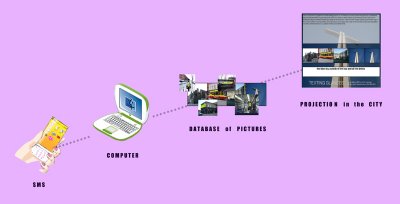
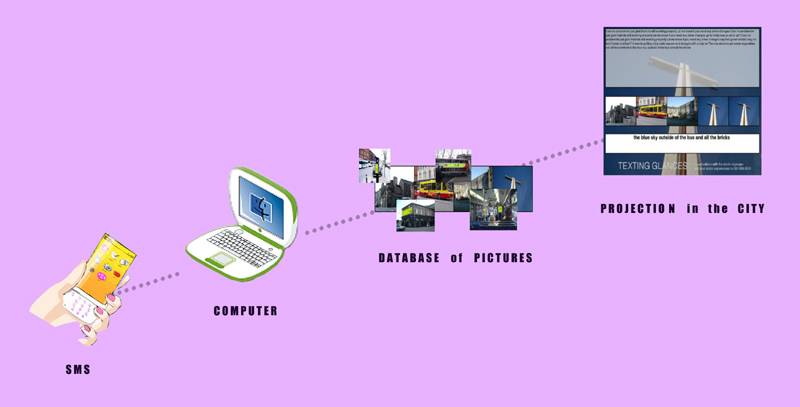
Imagined for installation in an urban, public space (bus stop, train station, etc.), PASSING GLANCES invites people to use SMS messaging on their cell phones to post images or video to a public display board. Display boards in different cities would be connected to one another. The system intelligently draws in other imagery to support the content of what users posted to the board. The goal was to have individuals describe their physical space in a substantial way, without the limitations of distance.

Through the supportive research on this application, I found that users were initially using SMS to experiment with the system, but then quickly preferred to make the unknown crowd react through anonymous posting to co-located users. On hindsight, this project had interesting implications for how digital technologies can mediate between how we assert ourselves privately and publicly within the physical space.

Connected to a server, each user’s cell phone could browse inside of their personal computer to display videos, pictures, and sound files. This was done privately and anonymously. The SMS media (picture, text, audio, etc.) posted to the display board could only be retrieved by specific users at a reasonable distance. Because these messages are unpredictable, they create an atmosphere of surprise and excitement.

People were motivated to explore the relationship of private and public roles through the act of anonymous posting in the physical space. However, I would like to expand the system to explore and model the public desire for “subversive” acts, their overlap with the desire to exchange new media and ideas, and how digital technologies can maximally support how these desires translate into the redesign of the physical space.

I designed this project in collaboration with Sven Anderson, Glorianna Davenport, Linda Doyle and Katherine Moriwaki when I was a researcher at Media Lab Europe. The origin of this work was to bring my previous project Textable Movie into a urban sms interactive display.

Web site
More info about Passing Glances


MOVING PICTURES
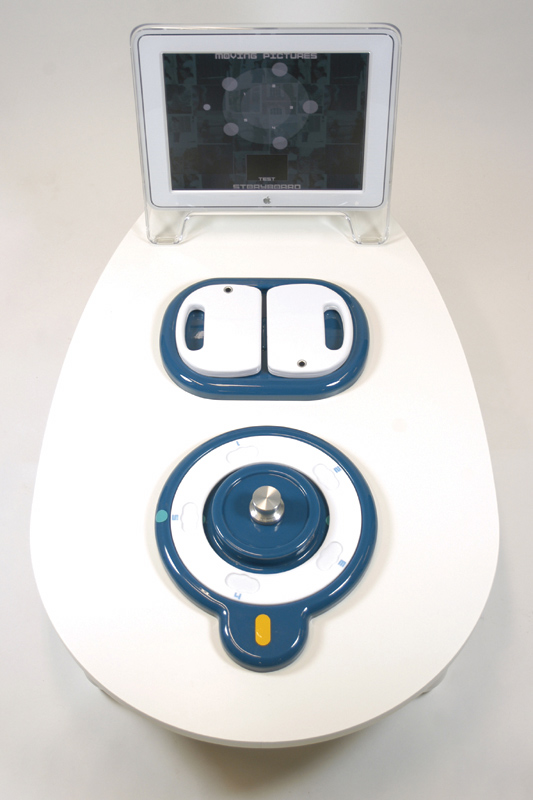
In the MOVING PICTURES project, I have sought to develop interfaces where either digital data can be overlaid onto physical objects in a display space or physical objects can act as handles into the digital space.

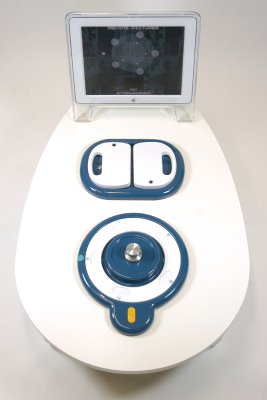
MOVING PICTURES offers children the opportunity to gather imagery from their environment in the form of short video clips captured on video camera platforms that we modified for the application. I wanted to provide a transparent experience for the user, in which cumbersome process of capturing and editing becomes fluid in the improvisation of a story is accessible as a way to create a final movie.

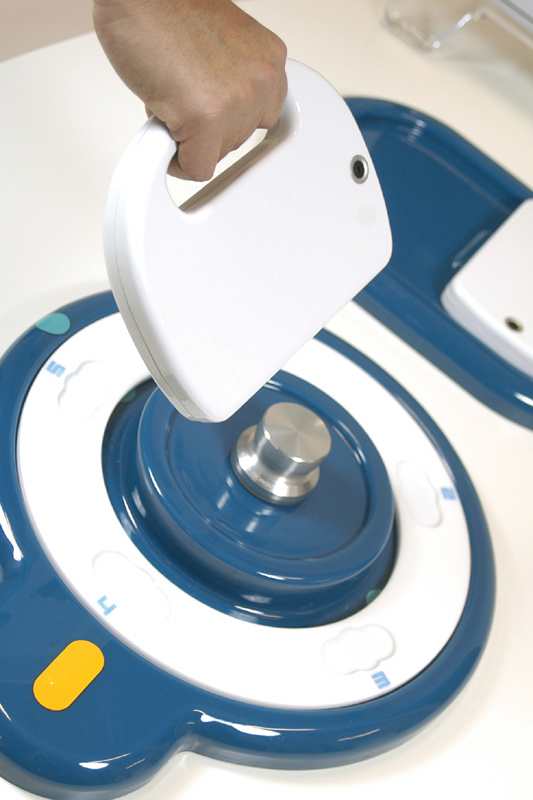
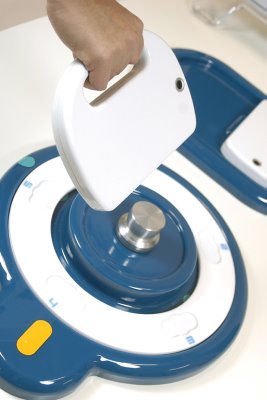
For editing, MOVING PICTURES includes a multi-user workstation consisting a set of two cameras, tokens, screen and an interactive platform where users to create, explore, manipulate and share video content with others. Multiple device input to the workstation supports group interaction and collaborative creation.

MOVING PICTURES suffers from several limitations related to the problem of how to best digitally support meaningful interactions in the physical space.

  • First the scalability of such system at a networked and international level is flawed. I need to redesign the software technology to centralize the linked data and distribute the nodes of contained data in an organized fashion. To have the technology better assist how an individual moves about the physical space while capturing content, their platform needs to be mediated by a centralized software architecture.


  • Second, system centralization implies new communication technology to mediate the video platforms and allow them to communicate with one another. The RFID technology in the wireless cameras could be redesigned into a pattern based technology using the video camera of any device.


  • Lastly, I would like to escape the hardware limitations of commercial video cameras. Users could use any phone, any camera or text based device to exchange material. The system should be designed to generalize despite different input modalities. All of these modifications shift the emphasis of the system from a simple, transparent, video platform, and into an architecture for supporting content generation that reflects the physical environment of the user through multiple information platforms.


  • I designed this project in collaboration with Diana Africano, Glorianna Davenport and Oskar Fjellstrom when I was a researcher at Media Lab Europe. The origin of this work was to bring my previous project Textable Movie into a tangible video editing platfofrm for children.
    More info on Moving Pictures


    TERRARIA
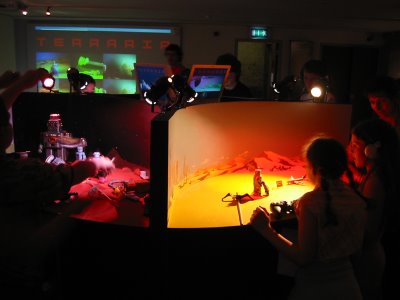
    TERRARIA was a system for visitors of a three-month exhibition in Dublin to author the content of the exhibition space by creating their own movies.

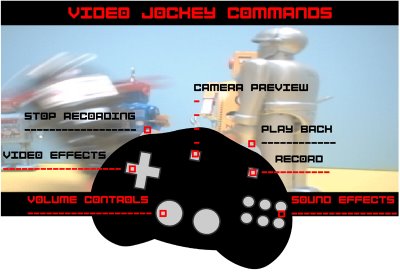
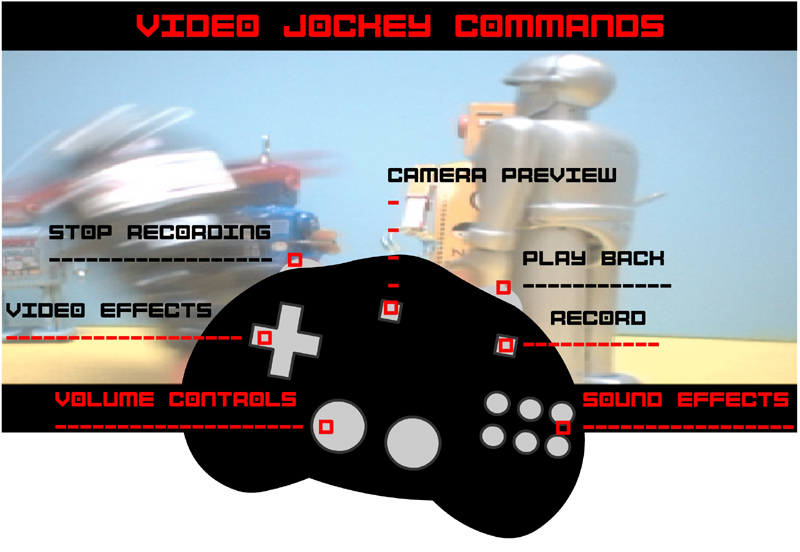
    I have designed a technology that enabled visitors to experience movie making using popular devices, e.g. a joystick to control the movie making process.

    I also re-thought real time video capturing and editing for the museum exhibition space by combining the traditionally separate capturing and editing processes. One can participate in the physical space through capturing video and export instantly to the digital space for the modification of the content they create.

    Finally, that content is projected within the museum, extending into the physical environment. Finally, the simplicity of use, and immediacy of response aims to engage visitors in movie creation. Video capture, editing and publication of the final video is optimized.

    With this interface I have attempted to expand the level of interaction for individuals in the physical museum space. Unlike the typical museum, spectators can transform and contribute to the physical exhibition space.

    Research on TERRARIA was primarily driven to optimize the video capturing and production process for the unique demands of the museum visitor and museum environment. The component of this work that is most exciting to me is the user capturing the physical space and immediately having the opportunity to re-project into that space with modifications of the video.

    If possible, I would like this process to be scaled across spaces, with distributed interfaces, and with computational models in place to describe how the users navigate the data representation and reproduction. Without the consistency of the museum I will need to rethink the display to visualize the content publicly. Investigating appropriateness of display and visualization create a critical component of all of this work.

    I designed this project in collaboration with Andrew Clancy, Michael John Gorman and Brendan Tangney when I was a researcher at Trinity College University in Dublin. Michael John Gorman was curating an exhibition on robots and offered me to design a platform for children to create and share their animations using robots.
    More info on Terraria