
Stick-A-Thing created pixel inspired 3D toys. The models are built with polystyrene. More pictures here.
Posted by Cati Vaucelle
♥ The Terminally Juvenile
- - - - - - - - - - - - - - - - - - - - - - - -
Showing posts with label product-design. Show all posts
Showing posts with label product-design. Show all posts
Friday, February 15, 2008
8BitBuddies™

Wednesday, December 26, 2007
Playground for all ages

The company Lappset designed Smart Us, a technological playground to connect all age users. Even though it is a very interesting concept and I cannot wait to try the interactive playground, I could not determine how it can really connect users of all ages, especially ederly. Thank you Susanne Jacobson for introducing me to this innovative Finish company!
SmartUs is a product concept developed by Lappset that uses technology to link the playground and its users. SmartUs offers interactive games for all age groups. The users can create games and applications based on images, sounds and text that support learning on the playground. The SmartUs product concept can be made use of in learning through play, playing computer games physically and in different kinds of well-being applications for special groups.
Among the four games available, the conquistador is a game of conquest, which gets people moving. Conquistador is played over the whole SmartUs field and players compete to be the first player or team to gain a specified number of different territories within the field. Territorial conquest is achieved by getting to the iPosts message poles and showing your iTag ID at the pole’s identification point. "It is especially suitable for players who are agile and alert. On the field, each player tries to conquer his/her own part of the game's fantasy world, and helps his/her team towards a common goal. The game develops tactical ability and teamwork skills."

Players carry on the iTag with them. The iTag sensor, distributed to users of the SmartUs environment is a key-sized sensor, that can be carried as a wrist watch or at a key chain.

What if we were 11 feet tall?

Yumiko Tanaka created SpyRod, a camera connected to a long stick with fishing line. The idea is that children can see and record the world from very different view points: a very low viewpoint, as if they were little creatures, a world as if they were giant or simply discover the world from their size-view.
By exploring the potential of new small cheap cameras, and by rethinking how children might use them, they stop being cameras and become third eyes.

Create your own doll

Oh, I Feel Naked!
Yes, I collect toys, toys that are charged with a period. Maybe this one is charged from the Victorian era, but I love it. It resembles a mix between a voodoo doll and a customizable one. If the author of the work, Eli Gutierrez, commercializes it, I immediately would get one!
Duct tape wallet


Anano
Just a post for the beauty of the eyes.
I followed the work of Anano since 2001. She designed my favorite bear characters. You can discover more pictures of her creations on her web site.


Later on she created a variety of objects and photographs, elegant, delicate, small and antique.


Two of her books on amazon
Petit a petit
Recevoir chez Anano
Sculpting Behavior

Hayes Raffle not only just had two full academic papers accepted to the first class conference IDC 2007: Interaction design and Children but he is also a talented sculptor and designer. His Super Cilia Skin reflects his aesthetic sensibility and his ongoing passion for kinetic sculpture.
Video
Super Cilia Skin
After co-creating and designing the award-winning ZOOB® building system, Hayes joined the Tangible Media Group at the MIT Media Laboratory and created Topobo, a 3D constructive assembly system with kinetic memory and the ability to record and playback physical motion.
Video
a ZOOB® creature
a Topobo creature
If you happen to be in the bay area, don't miss Hayes' talk, open to the public, that he is giving at the Berkeley Institute of Design, UC Berkeley, March 6th, from 1 to 2pm.
Information about his talk.
During the talk, he will explain how with Topobo children can assemble sculptures that dance and walk. He will present Fuzzmail a program that allow children to write a message that unfolds in time. He will show how with Jabberstamp children can embed stories, sounds and voices in their original drawings.
Marisa Jahn

Artist Marisa Jahn gave a talk at the MIT Media Lab, in the Tangible Media Group.
Her work explores ways to engage people in gaining knowledge, from literacy, to environmental literacy. She designed tools and methods to invite people in a comparative analysis of information and self-reflective process. She collaborates frequently with Steve Shada and Natalie Jeremijenko.
Interested in how human interact and communicate with each others, she designed wearable musical instruments.
video
For her master thesis in the visual studies department at MIT, she designed a game called Set. Elements of the set can be regrouped, labeled and organized and shared within the players.
video
Project most easily understood through direct engagement, boxSET is a game played as an intervention into any existing collection of objects (archives, record albums, a heap of junk—anything). Involving multiple players, some of whom may not have any prior relationship with the objects to be sorted, the game asks players to develop categories that describes a grouping of objects. However, the creation of order occurs simultaneous with disorder: a player may choose to remove an object from another player's collection in order to place it in his/her grouping. This rapid taxonomic metabolism encourages players to narrate out loud (or 'show-and-tell') their categories with the anticipation that it may soon disappear. Further, through taxonomically engaging with different kinds of objects, players become aware of what kinds of objects (data) are better for certain kinds of analyses (formal, textual, psychoanalytic, etc.). As the game evolves, players become aware of the difference in interpretation, the subjectivity of order, and the contingent production of knowledge.

She created throw-n-Sow a new way for people to think about and engage with their environment. Frisbees deposite seeds while in the air...
Throw-n-Sow is a flying disc toy similar to a Frisbee that uses the centripetal force generated in the act of throwing to distribute seeds into the environment. Manufactured as a toy made from environmentally-friendly, biodegradable plastics, Throw-n-Sow consists of a main body and a separate container that slides and locks under the disc. This container contains adjustable holes of different diameter to accommodate variant seed sizes. In other words, Throw-n-Sow is a literally empty container into which individuals and communities emplace selected seeds.
Throw-n-Sow is interactive eco-art project that engages diverse communities in each step of the project (manufacturing, seed-selection, site-selection, plant stewardship, art education), Throw-n-Sow raises questions about the expanded field of drawing, indigenous ecologies vs. selective human cultivation, landscape evolution and succession, ethnobotany, agronomy, etc. Throw-n-Sow ultimately aims to valorize distributive intelligence and interdisciplinary learning.
Throw-n-Sow is the kind of art that literally passes between two or more individuals. Leaving behind a trail of seeds as it sails through the air, Throw-n-Sow essentially imprints moments of play into the landscape. Individuals carrying the Throw-n-Sow disc from one place to another develop an affective relationship to the toy and to the sites in which it is deployed.

The influence of biotechnologies

Elio Caccavale is a product and interaction designer who explores the relationship between biotechnologies and our reactions to the "transhuman". He developped a series of toys that symbolize the emergence of biological hybrids.
MyBio bunny, MyBio glowing fish and MyBio jellyfish glow bright green when illuminated with a UV light, demonstrating how scientists have used GFP as a fluorescent indicator for monitoring gene expression in living organisms; MyBio reactor cow shows how cows produce proteins in their milk for pharmaceutical drugs (this is symbolized by the "milk thread" attached to the cow's udders); MyBio goat has a spider web attached to the udders demonstrating one animal making the natural product of another.
As Nicholas Negroponte said in Wired, beyond Digital, 1998: "The decades ahead will be a period of comprehending biotech, mastering nature, and realizing extraterrestrial travel, with DNA computers, microrobots, and nanotechnologies the main characters on the technological stage. Computers as we know them today will a) be boring, and b) disappear into things that are first and foremost something else: smart nails, self-cleaning shirts, driverless cars, therapeutic Barbie dolls, intelligent doorknobs that let the Federal Express man in and Fido out, but not 10 other dogs back in. Computers will be a sweeping yet invisible part of our everyday lives: We'll live in them, wear them, even eat them. A computer a day will keep the doctor away."
Now that the new technological stage described by Nicolas Negroponte is prominent, I study the materiality perceived through these technologies. I believe that this modification of our perception of the environment is developped through our experience with the digital.
Toy Fair (s)
I am fascinated by contemporary art exhibitions. If possible I try to attend La Biennale d'Art Contemporain in Lyon.
Another source of inspiration --that I have been told is adverse to contemporary art shows-- are Toy Shows. To me, toys are also inspirational as in the manner invention is linked to fashion and technology and they are meant to hacked, rediscovered and appropriated for one's own creative use. I also am interested in the evolution of the industrial aspect of a toy production.
Some Toy Fairs:
Middle Eastern toy fair in May
ABRIN-Brazilian Toy Fair in April
Tokyo Toy Show, The Japan Toy Association in July
There is also:
UNITED ARAB EMIRATES, Theme Parks & Fun Centres Show, May, CHINA, International Toy, Baby & Gift Fair, OCT, CHINESE TAIPEI, Taipei Domestic Toys & Children Articles Show- KOREA, Seoul International Toy Fair- SWEDEN, Stockholm Toy Fair
Another source of inspiration --that I have been told is adverse to contemporary art shows-- are Toy Shows. To me, toys are also inspirational as in the manner invention is linked to fashion and technology and they are meant to hacked, rediscovered and appropriated for one's own creative use. I also am interested in the evolution of the industrial aspect of a toy production.
Some Toy Fairs:
There is also:
UNITED ARAB EMIRATES, Theme Parks & Fun Centres Show, May, CHINA, International Toy, Baby & Gift Fair, OCT, CHINESE TAIPEI, Taipei Domestic Toys & Children Articles Show- KOREA, Seoul International Toy Fair- SWEDEN, Stockholm Toy Fair
PlayPals: Tangible Interfaces for Remote Communication and Play
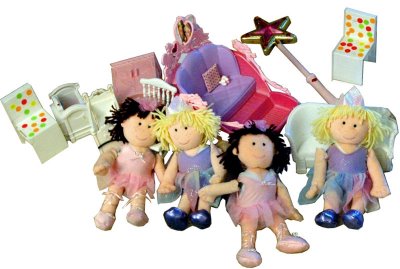
PlayPals are a set of wireless figurines with their electronic accessories that provide children with a playful way to communicate between remote locations. PlayPals is designed for children aged 5-8 to share multimedia experiences and virtual co-presence. We learned from our pilot study that embedding digital communication into existing play pattern enhances both remote play and communication
The project PlayPals is a team and class project for the Tangible Media class mid-term assignment at MIT Media Lab taught by Dr Hiroshi Ishii. It was presented as an extended Abstract of Conference on Human Factors in Computing Systems (CHI '06), (Montreal, Quebec, Canada. April 22-27, 2006) by Bonanni, L., Lieberman, J., Vaucelle, C., Zuckerman, O. (alphabetical order).
Our concept poster
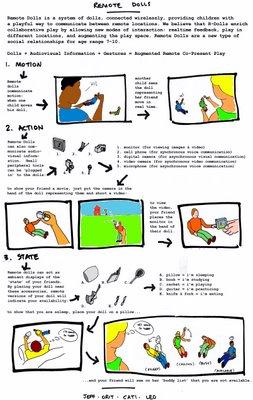
On this picture I interact with the doll, Leo being on the other end

Our implementation poster

By Cati in computational toy design
Subscribe to:
Posts (Atom)

