
Ecolibrium is a vast internet-based virtual world containing an ecosystem of thousands of semi-intelligent artificial life forms! It is still at a conceptual phase.
The idea is to construct a vast, internet-based virtual world containing an ecosystem of thousands of semi-intelligent artificial life forms. Children can create their own creatures and release them into the world to observe their creature's behavior and success within the ecosystem. They can study their creature's progress in order to learn about ecology, creature behaviour and other biological topics, while at the same time strengthening their ability to reason scientifically and gaining experience in modern 'systems' concepts such as Complexity and Chaos. The project is aimed at worldwide school and home use, and investigates cross-curricular activity.
- - - - - - - - - - - - - - - - - - - - - - - -
Blog Passion 
Thursday, March 13, 2008
Ecolibrium

Wednesday, February 20, 2008

Wednesday, December 26, 2007
Hungry stuffed animals

The Hungries by Dana Gordon is a family of plush monsters with an impressive appetite for RFID. Each Hungry has a different personality expressed with its own unique voice. It listens to the secrets whispered to its ear. When its arm is pulled, it plays them back in its own voice. When they are fed to one another, their voices are mixed in a burp-like way.
Playground for all ages

The company Lappset designed Smart Us, a technological playground to connect all age users. Even though it is a very interesting concept and I cannot wait to try the interactive playground, I could not determine how it can really connect users of all ages, especially ederly. Thank you Susanne Jacobson for introducing me to this innovative Finish company!
SmartUs is a product concept developed by Lappset that uses technology to link the playground and its users. SmartUs offers interactive games for all age groups. The users can create games and applications based on images, sounds and text that support learning on the playground. The SmartUs product concept can be made use of in learning through play, playing computer games physically and in different kinds of well-being applications for special groups.
Among the four games available, the conquistador is a game of conquest, which gets people moving. Conquistador is played over the whole SmartUs field and players compete to be the first player or team to gain a specified number of different territories within the field. Territorial conquest is achieved by getting to the iPosts message poles and showing your iTag ID at the pole’s identification point. "It is especially suitable for players who are agile and alert. On the field, each player tries to conquer his/her own part of the game's fantasy world, and helps his/her team towards a common goal. The game develops tactical ability and teamwork skills."

Players carry on the iTag with them. The iTag sensor, distributed to users of the SmartUs environment is a key-sized sensor, that can be carried as a wrist watch or at a key chain.


What if we were 11 feet tall?

Yumiko Tanaka created SpyRod, a camera connected to a long stick with fishing line. The idea is that children can see and record the world from very different view points: a very low viewpoint, as if they were little creatures, a world as if they were giant or simply discover the world from their size-view.
By exploring the potential of new small cheap cameras, and by rethinking how children might use them, they stop being cameras and become third eyes.

Interactive toy for autistic children

LINKX an interactive toy that stimulates the language development of autistic children. Via Idealist
Helma van RijnI designed LINKX, a language toy for autistic toddlers. Throughout the process, experts in autism were involved. She tested the prototype with three autistic children in several play-sessions.
The following is the video of her tests
Sculpting Behavior

Hayes Raffle not only just had two full academic papers accepted to the first class conference IDC 2007: Interaction design and Children but he is also a talented sculptor and designer. His Super Cilia Skin reflects his aesthetic sensibility and his ongoing passion for kinetic sculpture.
Video
Super Cilia Skin
After co-creating and designing the award-winning ZOOB® building system, Hayes joined the Tangible Media Group at the MIT Media Laboratory and created Topobo, a 3D constructive assembly system with kinetic memory and the ability to record and playback physical motion.
Video
a ZOOB® creature
a Topobo creature
If you happen to be in the bay area, don't miss Hayes' talk, open to the public, that he is giving at the Berkeley Institute of Design, UC Berkeley, March 6th, from 1 to 2pm.
Information about his talk.
During the talk, he will explain how with Topobo children can assemble sculptures that dance and walk. He will present Fuzzmail a program that allow children to write a message that unfolds in time. He will show how with Jabberstamp children can embed stories, sounds and voices in their original drawings.
Marisa Jahn

Artist Marisa Jahn gave a talk at the MIT Media Lab, in the Tangible Media Group.
Her work explores ways to engage people in gaining knowledge, from literacy, to environmental literacy. She designed tools and methods to invite people in a comparative analysis of information and self-reflective process. She collaborates frequently with Steve Shada and Natalie Jeremijenko.
Interested in how human interact and communicate with each others, she designed wearable musical instruments.
video
For her master thesis in the visual studies department at MIT, she designed a game called Set. Elements of the set can be regrouped, labeled and organized and shared within the players.
video
Project most easily understood through direct engagement, boxSET is a game played as an intervention into any existing collection of objects (archives, record albums, a heap of junk—anything). Involving multiple players, some of whom may not have any prior relationship with the objects to be sorted, the game asks players to develop categories that describes a grouping of objects. However, the creation of order occurs simultaneous with disorder: a player may choose to remove an object from another player's collection in order to place it in his/her grouping. This rapid taxonomic metabolism encourages players to narrate out loud (or 'show-and-tell') their categories with the anticipation that it may soon disappear. Further, through taxonomically engaging with different kinds of objects, players become aware of what kinds of objects (data) are better for certain kinds of analyses (formal, textual, psychoanalytic, etc.). As the game evolves, players become aware of the difference in interpretation, the subjectivity of order, and the contingent production of knowledge.

She created throw-n-Sow a new way for people to think about and engage with their environment. Frisbees deposite seeds while in the air...
Throw-n-Sow is a flying disc toy similar to a Frisbee that uses the centripetal force generated in the act of throwing to distribute seeds into the environment. Manufactured as a toy made from environmentally-friendly, biodegradable plastics, Throw-n-Sow consists of a main body and a separate container that slides and locks under the disc. This container contains adjustable holes of different diameter to accommodate variant seed sizes. In other words, Throw-n-Sow is a literally empty container into which individuals and communities emplace selected seeds.
Throw-n-Sow is interactive eco-art project that engages diverse communities in each step of the project (manufacturing, seed-selection, site-selection, plant stewardship, art education), Throw-n-Sow raises questions about the expanded field of drawing, indigenous ecologies vs. selective human cultivation, landscape evolution and succession, ethnobotany, agronomy, etc. Throw-n-Sow ultimately aims to valorize distributive intelligence and interdisciplinary learning.
Throw-n-Sow is the kind of art that literally passes between two or more individuals. Leaving behind a trail of seeds as it sails through the air, Throw-n-Sow essentially imprints moments of play into the landscape. Individuals carrying the Throw-n-Sow disc from one place to another develop an affective relationship to the toy and to the sites in which it is deployed.

The influence of biotechnologies

Elio Caccavale is a product and interaction designer who explores the relationship between biotechnologies and our reactions to the "transhuman". He developped a series of toys that symbolize the emergence of biological hybrids.
MyBio bunny, MyBio glowing fish and MyBio jellyfish glow bright green when illuminated with a UV light, demonstrating how scientists have used GFP as a fluorescent indicator for monitoring gene expression in living organisms; MyBio reactor cow shows how cows produce proteins in their milk for pharmaceutical drugs (this is symbolized by the "milk thread" attached to the cow's udders); MyBio goat has a spider web attached to the udders demonstrating one animal making the natural product of another.
As Nicholas Negroponte said in Wired, beyond Digital, 1998: "The decades ahead will be a period of comprehending biotech, mastering nature, and realizing extraterrestrial travel, with DNA computers, microrobots, and nanotechnologies the main characters on the technological stage. Computers as we know them today will a) be boring, and b) disappear into things that are first and foremost something else: smart nails, self-cleaning shirts, driverless cars, therapeutic Barbie dolls, intelligent doorknobs that let the Federal Express man in and Fido out, but not 10 other dogs back in. Computers will be a sweeping yet invisible part of our everyday lives: We'll live in them, wear them, even eat them. A computer a day will keep the doctor away."
Now that the new technological stage described by Nicolas Negroponte is prominent, I study the materiality perceived through these technologies. I believe that this modification of our perception of the environment is developped through our experience with the digital.
From Rubix cube to pixel picture
When the product meets the digital, a multitude of Rubix cubes becomes a mario brother pixel picture ...
By space-invaders
Process ...
Sweet Synthesizer

A cute example on how digital technologies can inspire our everyday creations: a cake synthesizer by Adam!
Video making: technology vs face-to-face

Moving Pictures
Recently, Kimberly Smith contacted me to discuss my work on Textable Movie. Textable Movie allows, by improvising movie-stories created from a personal video database and by suddenly being projected into someone else’s video database during the same story, to be surprised during the visualization of video elements corresponding to a story that correspond to someone else. I later introduced him the different stages of design from Textable Movie, Moving Pictures and Terraria. Review on these projects.
I originally created a methodology for international workshops on creative media making and sharing. My workshop is designed to engage teenagers from around the world in digital media making using the “textable movie” tool set. The workshop features a design cycle that begins with concept development and continues onto storyboarding, video production and editing; as it is realized, participants test and evaluate their video-stories using Textable Movie. Textable Movie is a graphical interface that takes text as input and allows users to improvise a movie in real-time based on the content of what they are writing. More about my workshop
The workshops global strategy focuses on fostering intercultural visual communication and play. One goal of the international program is to generate a cross-cultural study focused on the creative construction of media by teenagers.
Kimberly and I talked about the art of motion pictures being a language in itself.
For the past fifteen years, he has been passionately involved in using improvisation as a method for sharing what has been discovered about the language of motion pictures. His main concern is finding ways to emphasize the human element and de industrialize the process. He works with diverse groups of people ranging from severely disabled to experienced filmmakers.
All of his thinking tends to revolve around the idea of empowering people to acquire eloquence and skill with visual language and to be able to take control of the frame and thus the audience's attention. Responsibility for community and each other can be learned through this creative process. So it is more about social renewal and human development as it is about making movies, dixit Kimberly.
Kimberly sent me some samples of group movie making activities. All of these games use the same guide lines -or rules- found here.
I had integrated a few of these ideas in my international workshops with Textable Movie, but some of them are inspiring and new to me.
Ping Pong The idea is to move the audience's eye from left to right on the screen. This can be done a number of ways. dialogue is the easiest. Simply jump cut from one actor to the next and frame accordingly. Or pan from left to right. Or get the performers to move from left to right in the frame. Now the challenge is how do we smoothly accomplish this in a group where each individual gets a turn with the camera? We need common movie making language. In this case, each time a person hands off the camera, they have to tell the next person which side of the frame the visual focus was on. Thus the continuity is maintained. People learn very quickly when it is not. This game requires alertness almost the same way as something like Zip Zap Zop does. It can be timed or not. I've even had two teams compete.
In The Moment The idea is to emulate a fast paced current event news show. I did this one with the Irondale Ensemble in Halifax. We had a couple of cars so we were able to go to various locations across the city and stage "Live" interviews with group members posing as ordinary citizens. We payed attention to our framing (either left or right) and we shared the camera round robin. All edit-in-camera. Everyone had to pay close attention all the time and try to remember what had happened in the previous location as well as keep on top of the framing. The energy level was quite high. Our finished movie looked like a real live news show.
First Shot, Last Shot This game is built upon the idea that each individual shot contains an action that moves a story forward. So the first thing I do is have all the individuals in the group write down on little scraps of paper single shot ideas. For example: "angrily throwing a wad of paper in a trash can" or "biting a delicious apple or a bad one". I encourage the group to save these shot ideas on little scraps of paper that can be kept in a box or a hat. These can be used in a variety of games, but in this one, we break into two teams. Each one picks a first shot out of the hat -then a last shot. the object of the game is to create a story sequence that gets from the first shot to the last shot in twelve shots. The camera is passed from individual to individual. No one is allowed more than one shot at a time and each shot has to be no longer than thirty seconds. All members of the team must appear in front of the camera at least once. Again this is all done edit-in-camera. So everyone has to be on their toes at all times. The game can be timed or not and the sequence can have more than twelve shots or less. We've done this as an easy going, inclusive recreational activity on a Saturday afternoon and the movie was played after a pot luck supper.
Power Shift This game is challenging for performers and shooters because it requires strategic freezing of the action without losing the flow of the movie. Other games do this too, but this one emphasizes the problem. This requires a group of five or more. Three or more people must be on camera at all times. The idea is to have a spontaneous feeling, dynamic group discussion or argument where individuals come and go because they have been bullied out or are pulling a power trip. The point of focus with the camera is to be aware of the axis at all times. So when a person hands the camera to the next person they can pass the information along and maintain directional continuity. This is an advanced game and again it can be done like a team sport with two groups competing within time parameters or limited numbers of shots.
Beam Us Up This game requires a tripod. The idea is to use "lock-off" camera positions to create Star Trek like transporter special effects. The dramatic point is something is wrong with the transporter - some people disappear and new ones emerge. Again the camera is shared round robin. So this is what changes up the personnel, but the real challenge is trying to remember how people were positioned in the last location so when they re emerge, they are still in the same physical relationship with each other. Its harder than people think, but kids of all ages love this game. The way it works is the camera is rock solidly framed wide on a certain empty location and you record a few seconds. Then you bring the group in and have them freeze in transporter position. Simply roll the camera again without moving it a millimetre and the group will appear out of nowhere. Some cameras have an overlap dissolve which makes the group seem to fade in. Its fun and the dramatic possibilities are wide open. This idea can be combined with other games like "In The Moment" to create wild, Wellsian stories.
Who Am I? This is a P.O.V. game. Again it is edit-in-camera and passed round robin from individual to individual in the group. Camera operators choose a certain P.O.V. either dynamic or static and the actors interact with the camera in such a way that the identity of the camera is implied, but not expressly given away. I usually remind the players not to hog the camera and figure out how to create connecting shots so the camera can be passed to the next player. All the visual rules remain the same. This game is played in teams. One group has to watch the other's sequence and correctly identify the camera's character.
I found very interesting his approach, developed from Viola Spolin's Theatre Games.
All of them are designed with specific points of focus and they also accelerate the process of learning the language of motion pictures. But more importantly than all of this is the breaking down of the industrial hierarchy. My main goal is to foster inclusiveness, community pride and creativity.
For a researcher in HCI, who designs new tools and technology to allow improvisation, collaboration and creativity, it is very exciting to hear what video makers & educators invest and develop from a day to day basis on these subjects.
I/O brush
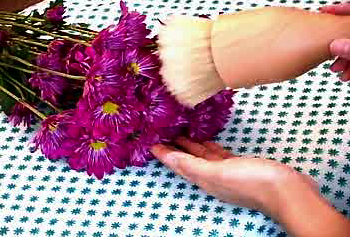

On the canvas, artists can draw with the special "ink" they just picked up from their immediate environment.
My colleague and friend Kimiko Ryokai joined the faculty of the School of Information, Berleley, in January 2007. She teach in the iSchool and the Center for New Media. She graduated from the Tangible Media Group at MIT Media Lab with Dr. Hiroshi Ishii. She is currently employed at the product design firm, IDEO.
A while back for her PhD, Kimiko designed io brush, a super intuitive platform to paint digitally using colors, patterns, movements that surround us. For her master thesis she invented and researched on Storymat, a pretty mat that stores children's storytelling play by recording their voices and movements of the toys they play with.
IO brush movie that I recommend watching (25 mb). Delight warrantied.
A haptic psycho therapeutic Barbie for violent kids?

Recently, Florence Gallez --Moscow correspondent for the Bureau of National Affairs-- sent me two articles about the future of the Barbie dolls. Either to mention that it is time to kill her or that 'Barbie's new dad is searching for the doll's missing wow' ...
Well, I remember a WOW and this by only switching voices between Barbie and GI Joe dolls. Maybe Mattel could receive some advice from Mike Bonanno (the Yes men) ...
In any case, I think it is time for us to make a Psycho-therapeutic Barbie that squeezes violent kids with her tiny little hands ...

Barbie as Cat Woman
Les Nabaztag sont trop forts!
So not only they are super cool to have, my friend Matthieu had one when I came visit him in Paris this winter, but now they do operas.
Petit commentaire au passage: If you type Nabaztag on Flickr, you get 594 pictures of the rabbit (including mine!)
So I found on Etienne Minneur's blog (who happens to be my graphic design professor from 1997-1999 while I studied at Paris VIII -- I am very proud of this fact, because I adore what he does)-- that Jean-Jacques Birgé worked with Antoine Schmitt on an opera for 100 Nabztags! This was for the ceremony of the Flash Festival 2006.
Toy Fair (s)
Another source of inspiration --that I have been told is adverse to contemporary art shows-- are Toy Shows. To me, toys are also inspirational as in the manner invention is linked to fashion and technology and they are meant to hacked, rediscovered and appropriated for one's own creative use. I also am interested in the evolution of the industrial aspect of a toy production.
Some Toy Fairs:
There is also:
UNITED ARAB EMIRATES, Theme Parks & Fun Centres Show, May, CHINA, International Toy, Baby & Gift Fair, OCT, CHINESE TAIPEI, Taipei Domestic Toys & Children Articles Show- KOREA, Seoul International Toy Fair- SWEDEN, Stockholm Toy Fair
My review on a selection of personal past research
The following are three examples of my work with features that can be re-appropriated to found new research directions pertaining to my future research question.
Passing Glances
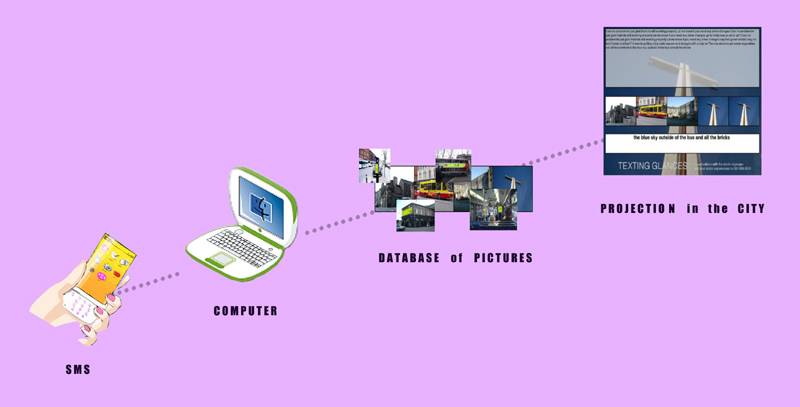
Imagined for installation in an urban, public space (bus stop, train station, etc.), PASSING GLANCES invites people to use SMS messaging on their cell phones to post images or video to a public display board. Display boards in different cities would be connected to one another. The system intelligently draws in other imagery to support the content of what users posted to the board. The goal was to have individuals describe their physical space in a substantial way, without the limitations of distance.
Through the supportive research on this application, I found that users were initially using SMS to experiment with the system, but then quickly preferred to make the unknown crowd react through anonymous posting to co-located users. On hindsight, this project had interesting implications for how digital technologies can mediate between how we assert ourselves privately and publicly within the physical space.
Connected to a server, each user’s cell phone could browse inside of their personal computer to display videos, pictures, and sound files. This was done privately and anonymously. The SMS media (picture, text, audio, etc.) posted to the display board could only be retrieved by specific users at a reasonable distance. Because these messages are unpredictable, they create an atmosphere of surprise and excitement.
People were motivated to explore the relationship of private and public roles through the act of anonymous posting in the physical space. However, I would like to expand the system to explore and model the public desire for “subversive” acts, their overlap with the desire to exchange new media and ideas, and how digital technologies can maximally support how these desires translate into the redesign of the physical space.
I designed this project in collaboration with Sven Anderson, Glorianna Davenport, Linda Doyle and Katherine Moriwaki when I was a researcher at Media Lab Europe. The origin of this work was to bring my previous project Textable Movie into a urban sms interactive display.
Web site
More info about Passing Glances
MOVING PICTURES
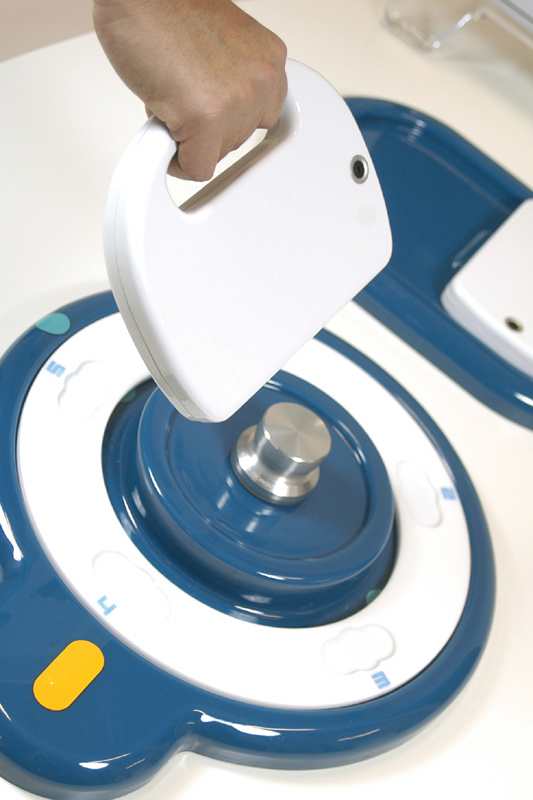
In the MOVING PICTURES project, I have sought to develop interfaces where either digital data can be overlaid onto physical objects in a display space or physical objects can act as handles into the digital space.
MOVING PICTURES offers children the opportunity to gather imagery from their environment in the form of short video clips captured on video camera platforms that we modified for the application. I wanted to provide a transparent experience for the user, in which cumbersome process of capturing and editing becomes fluid in the improvisation of a story is accessible as a way to create a final movie.
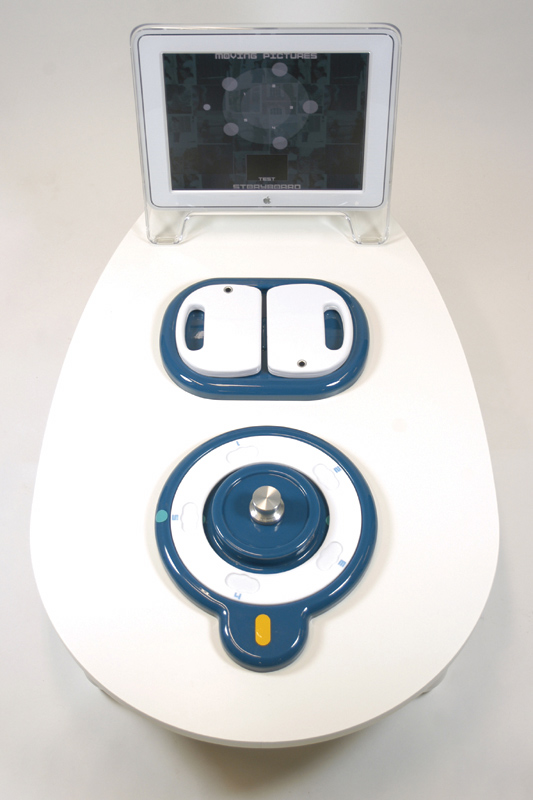
For editing, MOVING PICTURES includes a multi-user workstation consisting a set of two cameras, tokens, screen and an interactive platform where users to create, explore, manipulate and share video content with others. Multiple device input to the workstation supports group interaction and collaborative creation.
MOVING PICTURES suffers from several limitations related to the problem of how to best digitally support meaningful interactions in the physical space.
I designed this project in collaboration with Diana Africano, Glorianna Davenport and Oskar Fjellstrom when I was a researcher at Media Lab Europe. The origin of this work was to bring my previous project Textable Movie into a tangible video editing platfofrm for children.
More info on Moving Pictures
TERRARIA
TERRARIA was a system for visitors of a three-month exhibition in Dublin to author the content of the exhibition space by creating their own movies.
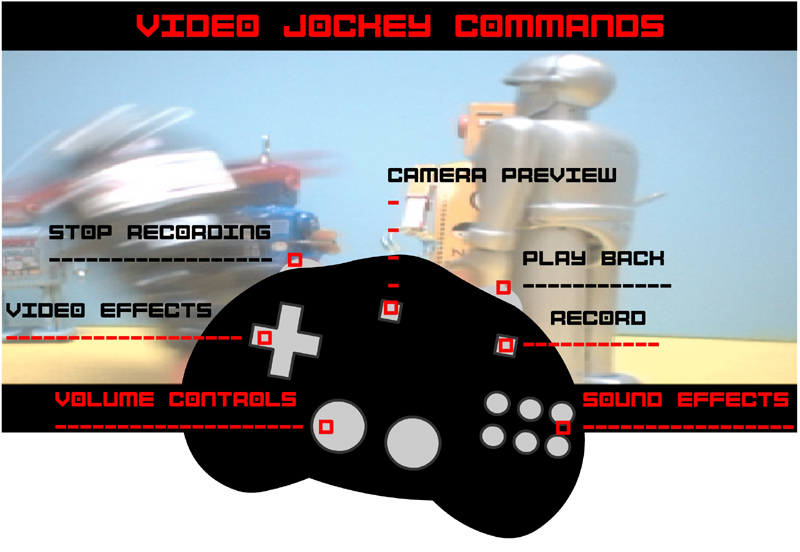
I have designed a technology that enabled visitors to experience movie making using popular devices, e.g. a joystick to control the movie making process.
I also re-thought real time video capturing and editing for the museum exhibition space by combining the traditionally separate capturing and editing processes. One can participate in the physical space through capturing video and export instantly to the digital space for the modification of the content they create.
Finally, that content is projected within the museum, extending into the physical environment. Finally, the simplicity of use, and immediacy of response aims to engage visitors in movie creation. Video capture, editing and publication of the final video is optimized.
With this interface I have attempted to expand the level of interaction for individuals in the physical museum space. Unlike the typical museum, spectators can transform and contribute to the physical exhibition space.
Research on TERRARIA was primarily driven to optimize the video capturing and production process for the unique demands of the museum visitor and museum environment. The component of this work that is most exciting to me is the user capturing the physical space and immediately having the opportunity to re-project into that space with modifications of the video.
If possible, I would like this process to be scaled across spaces, with distributed interfaces, and with computational models in place to describe how the users navigate the data representation and reproduction. Without the consistency of the museum I will need to rethink the display to visualize the content publicly. Investigating appropriateness of display and visualization create a critical component of all of this work.
I designed this project in collaboration with Andrew Clancy, Michael John Gorman and Brendan Tangney when I was a researcher at Trinity College University in Dublin. Michael John Gorman was curating an exhibition on robots and offered me to design a platform for children to create and share their animations using robots.
More info on Terraria

PlayPals: Tangible Interfaces for Remote Communication and Play
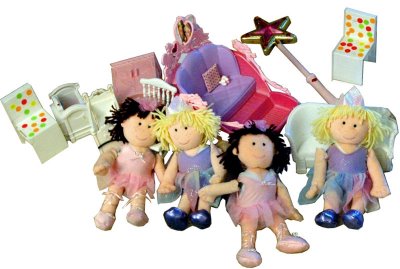
PlayPals are a set of wireless figurines with their electronic accessories that provide children with a playful way to communicate between remote locations. PlayPals is designed for children aged 5-8 to share multimedia experiences and virtual co-presence. We learned from our pilot study that embedding digital communication into existing play pattern enhances both remote play and communication
The project PlayPals is a team and class project for the Tangible Media class mid-term assignment at MIT Media Lab taught by Dr Hiroshi Ishii. It was presented as an extended Abstract of Conference on Human Factors in Computing Systems (CHI '06), (Montreal, Quebec, Canada. April 22-27, 2006) by Bonanni, L., Lieberman, J., Vaucelle, C., Zuckerman, O. (alphabetical order).
Our concept poster
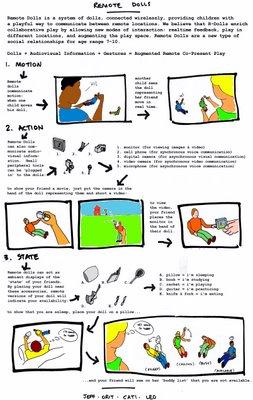
On this picture I interact with the doll, Leo being on the other end

Our implementation poster

Saturday, November 24, 2007
How to paint a dunny

Yuko Shimizu's dunny painted in black and white oil based enamel.

Kidrobot's Paint Ball to benefit Save The Children foundation was held in September of 2006 in New York City. Each artist was given a blank 20" Dunny as a canvas to work on. After the public viewing, Dunnies were auctioned off through Ebay and all the proceeds were donated to Save The Children Foundation.

