
The Hungries by Dana Gordon is a family of plush monsters with an impressive appetite for RFID. Each Hungry has a different personality expressed with its own unique voice. It listens to the secrets whispered to its ear. When its arm is pulled, it plays them back in its own voice. When they are fed to one another, their voices are mixed in a burp-like way.
Showing posts with label technology. Show all posts
Showing posts with label technology. Show all posts
Wednesday, December 26, 2007
Hungry stuffed animals

A tiny robot walked in my office today ...


Ricordo
EMRos is this family of so-called World’s smallest autonomous self-propelled micro robots. Each creature is this tiny robot that can record and play back motions being guided by a flashlight.
Ricordo is 1 cm3 in volume and equipped with a recording and playback function. Rubie on the other end is equipped with capricious wandering function. Both were created by Epson in 1995, but I finally got to play with one today, and it is adorable! I found a web site that shows beautiful pictures of the robots as well as the nice packaging that hosts them!
What if we were 11 feet tall?

Yumiko Tanaka created SpyRod, a camera connected to a long stick with fishing line. The idea is that children can see and record the world from very different view points: a very low viewpoint, as if they were little creatures, a world as if they were giant or simply discover the world from their size-view.
By exploring the potential of new small cheap cameras, and by rethinking how children might use them, they stop being cameras and become third eyes.

Sculpting Behavior

Hayes Raffle not only just had two full academic papers accepted to the first class conference IDC 2007: Interaction design and Children but he is also a talented sculptor and designer. His Super Cilia Skin reflects his aesthetic sensibility and his ongoing passion for kinetic sculpture.
Video
Super Cilia Skin
After co-creating and designing the award-winning ZOOB® building system, Hayes joined the Tangible Media Group at the MIT Media Laboratory and created Topobo, a 3D constructive assembly system with kinetic memory and the ability to record and playback physical motion.
Video
a ZOOB® creature
a Topobo creature
If you happen to be in the bay area, don't miss Hayes' talk, open to the public, that he is giving at the Berkeley Institute of Design, UC Berkeley, March 6th, from 1 to 2pm.
Information about his talk.
During the talk, he will explain how with Topobo children can assemble sculptures that dance and walk. He will present Fuzzmail a program that allow children to write a message that unfolds in time. He will show how with Jabberstamp children can embed stories, sounds and voices in their original drawings.
The influence of biotechnologies

Elio Caccavale is a product and interaction designer who explores the relationship between biotechnologies and our reactions to the "transhuman". He developped a series of toys that symbolize the emergence of biological hybrids.
MyBio bunny, MyBio glowing fish and MyBio jellyfish glow bright green when illuminated with a UV light, demonstrating how scientists have used GFP as a fluorescent indicator for monitoring gene expression in living organisms; MyBio reactor cow shows how cows produce proteins in their milk for pharmaceutical drugs (this is symbolized by the "milk thread" attached to the cow's udders); MyBio goat has a spider web attached to the udders demonstrating one animal making the natural product of another.
As Nicholas Negroponte said in Wired, beyond Digital, 1998: "The decades ahead will be a period of comprehending biotech, mastering nature, and realizing extraterrestrial travel, with DNA computers, microrobots, and nanotechnologies the main characters on the technological stage. Computers as we know them today will a) be boring, and b) disappear into things that are first and foremost something else: smart nails, self-cleaning shirts, driverless cars, therapeutic Barbie dolls, intelligent doorknobs that let the Federal Express man in and Fido out, but not 10 other dogs back in. Computers will be a sweeping yet invisible part of our everyday lives: We'll live in them, wear them, even eat them. A computer a day will keep the doctor away."
Now that the new technological stage described by Nicolas Negroponte is prominent, I study the materiality perceived through these technologies. I believe that this modification of our perception of the environment is developped through our experience with the digital.
From Rubix cube to pixel picture
When the product meets the digital, a multitude of Rubix cubes becomes a mario brother pixel picture ...
By space-invaders
Process ...
Sweet Synthesizer

A cute example on how digital technologies can inspire our everyday creations: a cake synthesizer by Adam!
I/O brush
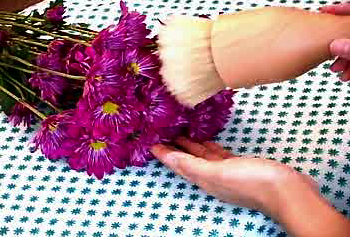

On the canvas, artists can draw with the special "ink" they just picked up from their immediate environment.
My colleague and friend Kimiko Ryokai joined the faculty of the School of Information, Berleley, in January 2007. She teach in the iSchool and the Center for New Media. She graduated from the Tangible Media Group at MIT Media Lab with Dr. Hiroshi Ishii. She is currently employed at the product design firm, IDEO.
A while back for her PhD, Kimiko designed io brush, a super intuitive platform to paint digitally using colors, patterns, movements that surround us. For her master thesis she invented and researched on Storymat, a pretty mat that stores children's storytelling play by recording their voices and movements of the toys they play with.
IO brush movie that I recommend watching (25 mb). Delight warrantied.
Les Nabaztag sont trop forts!
So not only they are super cool to have, my friend Matthieu had one when I came visit him in Paris this winter, but now they do operas.
Petit commentaire au passage: If you type Nabaztag on Flickr, you get 594 pictures of the rabbit (including mine!)
So I found on Etienne Minneur's blog (who happens to be my graphic design professor from 1997-1999 while I studied at Paris VIII -- I am very proud of this fact, because I adore what he does)-- that Jean-Jacques Birgé worked with Antoine Schmitt on an opera for 100 Nabztags! This was for the ceremony of the Flash Festival 2006.
My review on a selection of personal past research
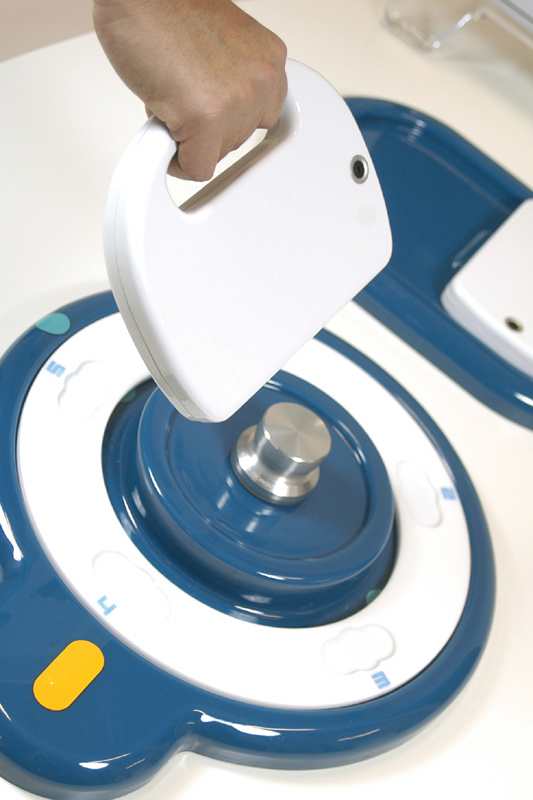
The following are three examples of my work with features that can be re-appropriated to found new research directions pertaining to my future research question.
Passing Glances
Imagined for installation in an urban, public space (bus stop, train station, etc.), PASSING GLANCES invites people to use SMS messaging on their cell phones to post images or video to a public display board. Display boards in different cities would be connected to one another. The system intelligently draws in other imagery to support the content of what users posted to the board. The goal was to have individuals describe their physical space in a substantial way, without the limitations of distance.
Through the supportive research on this application, I found that users were initially using SMS to experiment with the system, but then quickly preferred to make the unknown crowd react through anonymous posting to co-located users. On hindsight, this project had interesting implications for how digital technologies can mediate between how we assert ourselves privately and publicly within the physical space.
Connected to a server, each user’s cell phone could browse inside of their personal computer to display videos, pictures, and sound files. This was done privately and anonymously. The SMS media (picture, text, audio, etc.) posted to the display board could only be retrieved by specific users at a reasonable distance. Because these messages are unpredictable, they create an atmosphere of surprise and excitement.
People were motivated to explore the relationship of private and public roles through the act of anonymous posting in the physical space. However, I would like to expand the system to explore and model the public desire for “subversive” acts, their overlap with the desire to exchange new media and ideas, and how digital technologies can maximally support how these desires translate into the redesign of the physical space.
I designed this project in collaboration with Sven Anderson, Glorianna Davenport, Linda Doyle and Katherine Moriwaki when I was a researcher at Media Lab Europe. The origin of this work was to bring my previous project Textable Movie into a urban sms interactive display.
Web site
More info about Passing Glances
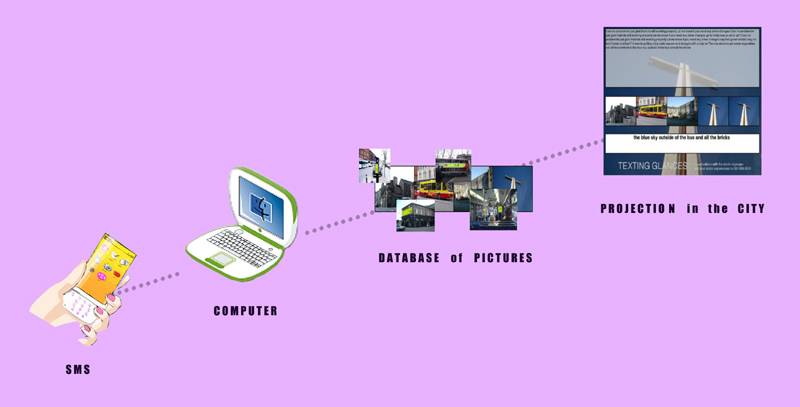
MOVING PICTURES
In the MOVING PICTURES project, I have sought to develop interfaces where either digital data can be overlaid onto physical objects in a display space or physical objects can act as handles into the digital space.
MOVING PICTURES offers children the opportunity to gather imagery from their environment in the form of short video clips captured on video camera platforms that we modified for the application. I wanted to provide a transparent experience for the user, in which cumbersome process of capturing and editing becomes fluid in the improvisation of a story is accessible as a way to create a final movie.
For editing, MOVING PICTURES includes a multi-user workstation consisting a set of two cameras, tokens, screen and an interactive platform where users to create, explore, manipulate and share video content with others. Multiple device input to the workstation supports group interaction and collaborative creation.
MOVING PICTURES suffers from several limitations related to the problem of how to best digitally support meaningful interactions in the physical space.
I designed this project in collaboration with Diana Africano, Glorianna Davenport and Oskar Fjellstrom when I was a researcher at Media Lab Europe. The origin of this work was to bring my previous project Textable Movie into a tangible video editing platfofrm for children.
More info on Moving Pictures
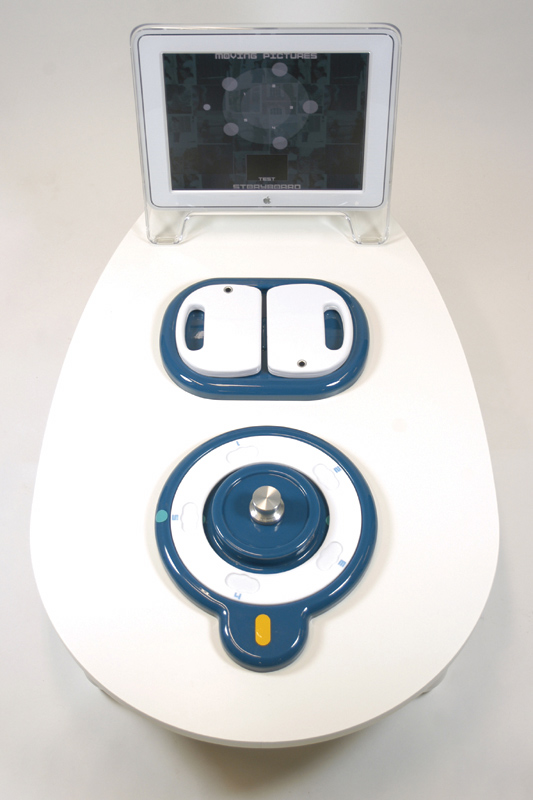
TERRARIA
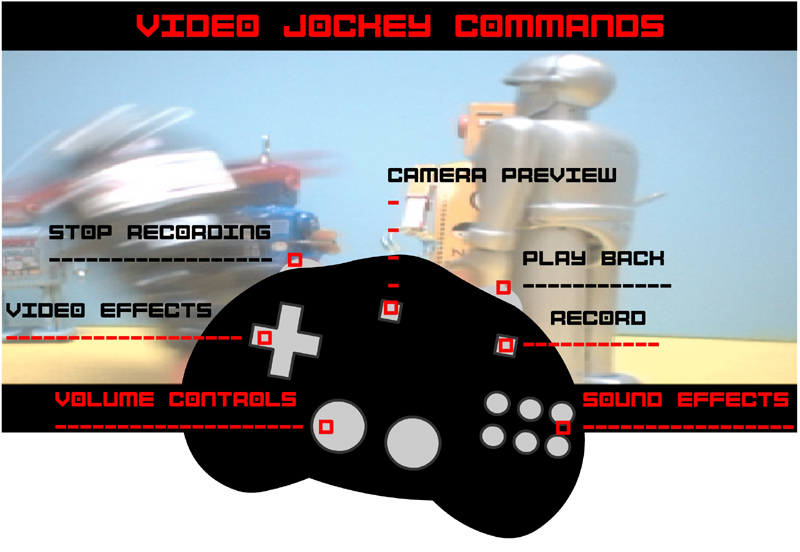
TERRARIA was a system for visitors of a three-month exhibition in Dublin to author the content of the exhibition space by creating their own movies.
I have designed a technology that enabled visitors to experience movie making using popular devices, e.g. a joystick to control the movie making process.
I also re-thought real time video capturing and editing for the museum exhibition space by combining the traditionally separate capturing and editing processes. One can participate in the physical space through capturing video and export instantly to the digital space for the modification of the content they create.
Finally, that content is projected within the museum, extending into the physical environment. Finally, the simplicity of use, and immediacy of response aims to engage visitors in movie creation. Video capture, editing and publication of the final video is optimized.
With this interface I have attempted to expand the level of interaction for individuals in the physical museum space. Unlike the typical museum, spectators can transform and contribute to the physical exhibition space.
Research on TERRARIA was primarily driven to optimize the video capturing and production process for the unique demands of the museum visitor and museum environment. The component of this work that is most exciting to me is the user capturing the physical space and immediately having the opportunity to re-project into that space with modifications of the video.
If possible, I would like this process to be scaled across spaces, with distributed interfaces, and with computational models in place to describe how the users navigate the data representation and reproduction. Without the consistency of the museum I will need to rethink the display to visualize the content publicly. Investigating appropriateness of display and visualization create a critical component of all of this work.
I designed this project in collaboration with Andrew Clancy, Michael John Gorman and Brendan Tangney when I was a researcher at Trinity College University in Dublin. Michael John Gorman was curating an exhibition on robots and offered me to design a platform for children to create and share their animations using robots.
More info on Terraria

PlayPals: Tangible Interfaces for Remote Communication and Play
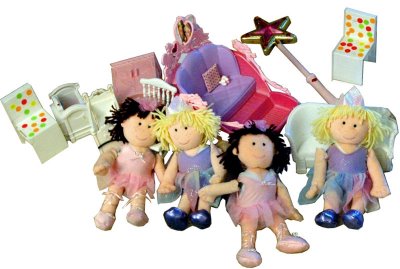
PlayPals are a set of wireless figurines with their electronic accessories that provide children with a playful way to communicate between remote locations. PlayPals is designed for children aged 5-8 to share multimedia experiences and virtual co-presence. We learned from our pilot study that embedding digital communication into existing play pattern enhances both remote play and communication
The project PlayPals is a team and class project for the Tangible Media class mid-term assignment at MIT Media Lab taught by Dr Hiroshi Ishii. It was presented as an extended Abstract of Conference on Human Factors in Computing Systems (CHI '06), (Montreal, Quebec, Canada. April 22-27, 2006) by Bonanni, L., Lieberman, J., Vaucelle, C., Zuckerman, O. (alphabetical order).
Our concept poster
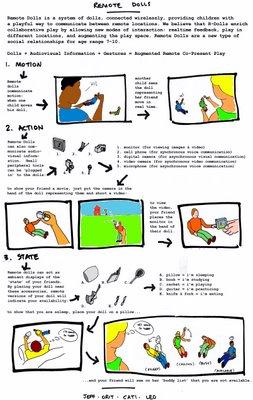
On this picture I interact with the doll, Leo being on the other end

Our implementation poster

By Cati in computational toy design
Subscribe to:
Posts (Atom)

