Wednesday, December 26, 2007

I/O brush


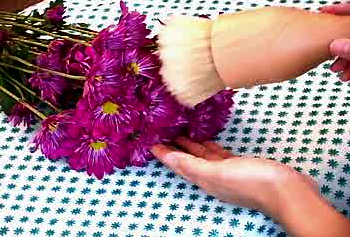
On the canvas, artists can draw with the special "ink" they just picked up from their immediate environment.


My colleague and friend Kimiko Ryokai joined the faculty of the School of Information, Berleley, in January 2007. She teach in the iSchool and the Center for New Media. She graduated from the Tangible Media Group at MIT Media Lab with Dr. Hiroshi Ishii. She is currently employed at the product design firm, IDEO.

A while back for her PhD, Kimiko designed io brush, a super intuitive platform to paint digitally using colors, patterns, movements that surround us. For her master thesis she invented and researched on Storymat, a pretty mat that stores children's storytelling play by recording their voices and movements of the toys they play with.

IO brush movie that I recommend watching (25 mb). Delight warrantied.

A Carrie Outfit for Barbie


After having designed a Tomb for my Barbie, I have designed a Carrie Outfit.

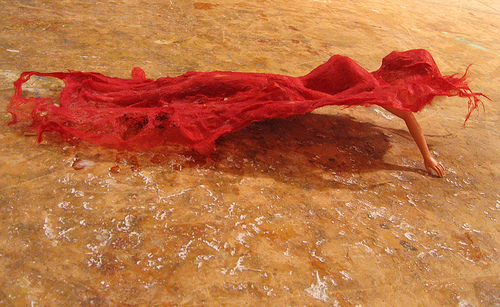
Barbie has a Ken, a Corvette, a castle, and all the outfits she ever wanted. However she has nothing for Halloween. I designed this outfit in Papier Mache to fit the Barbie we love.

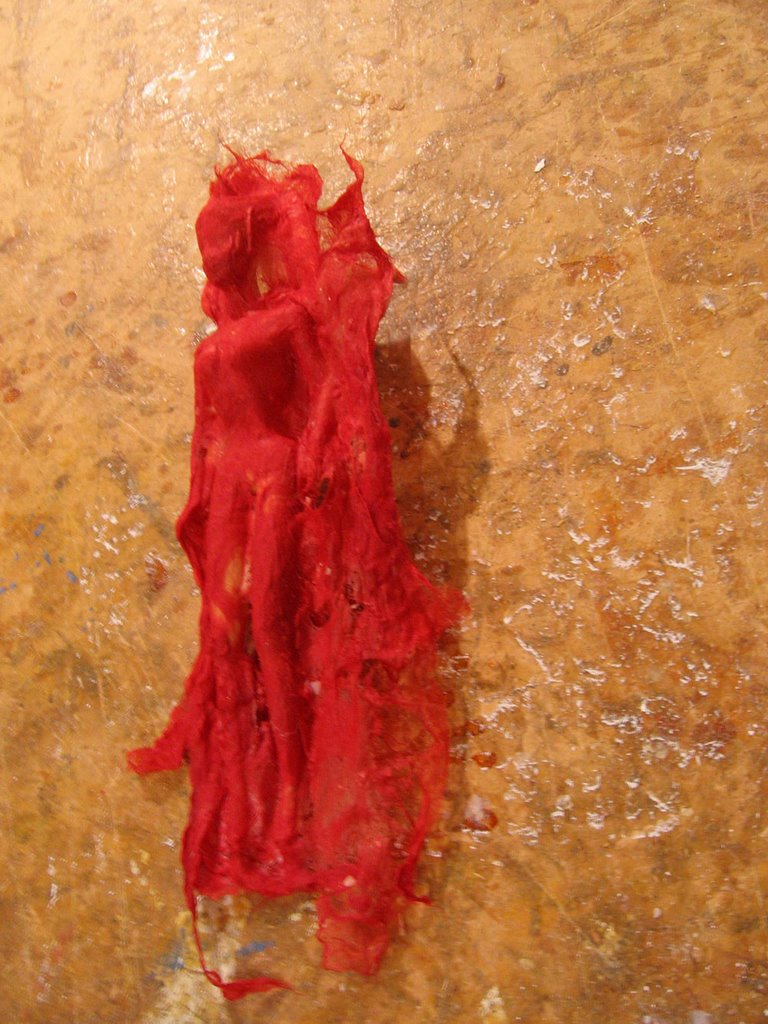
The following picture shows that the outfit has taken the perfect shape of the Barbie doll.


A Carrie Outfit for Barbie in Papier maché (doll not included)

More pictures on Flickr ...

Core sample


Material: wax and plaster

I took the perspective of a child trying to understand the meaning of the term Core Sample, an intuitive translation from the French analogy. Core sample then means 'le corps samplé', i.e. dismembered body.
An immediate reference to the dismembered body is a serial killer, the one that would be prompt to body sampling. Starting with an obsession for the neck, to a more tool-istic approach to body members: arms, legs, feet. I made a rock that symbolizes le plan de travail.

I chose to dismember a Barbie doll that I created out of wax. The Barbie being for a while a representation of the woman for a child. I chose the white wax, the wax being a way a woman suffers regularly by trying to reach an ideal. The white is the symbole of purity thus the contrast between the canvas fabric & the plaster sculpted with chisel, and the angelic face of the doll made of white wax.

This sculpture is a tool-kit box for understanding serial killing for children. The tools are also made of wax and represent legs, arms, hands, feet. A tool is normally very hard, here it is very fragile as a mean to represent the complete chimère, i.e. pipe dream, the serial killer is immersed in.


More pictures on Flickr

I made this sculpture for the sculpture class taught by Helen Mirra at Harvard University, VES.

A haptic psycho therapeutic Barbie for violent kids?


Recently, Florence Gallez --Moscow correspondent for the Bureau of National Affairs-- sent me two articles about the future of the Barbie dolls. Either to mention that it is time to kill her or that 'Barbie's new dad is searching for the doll's missing wow' ...
Well, I remember a WOW and this by only switching voices between Barbie and GI Joe dolls. Maybe Mattel could receive some advice from Mike Bonanno (the Yes men) ...

In any case, I think it is time for us to make a Psycho-therapeutic Barbie that squeezes violent kids with her tiny little hands ...


Barbie as Cat Woman

Les Nabaztag sont trop forts!

So not only they are super cool to have, my friend Matthieu had one when I came visit him in Paris this winter, but now they do operas.


Petit commentaire au passage: If you type Nabaztag on Flickr, you get 594 pictures of the rabbit (including mine!)

So I found on Etienne Minneur's blog (who happens to be my graphic design professor from 1997-1999 while I studied at Paris VIII -- I am very proud of this fact, because I adore what he does)-- that Jean-Jacques Birgé worked with Antoine Schmitt on an opera for 100 Nabztags! This was for the ceremony of the Flash Festival 2006.

Toy Fair (s)

I am fascinated by contemporary art exhibitions. If possible I try to attend La Biennale d'Art Contemporain in Lyon.
Another source of inspiration --that I have been told is adverse to contemporary art shows-- are Toy Shows. To me, toys are also inspirational as in the manner invention is linked to fashion and technology and they are meant to hacked, rediscovered and appropriated for one's own creative use. I also am interested in the evolution of the industrial aspect of a toy production.

Some Toy Fairs:

  • Middle Eastern toy fair in May

  • ABRIN-Brazilian Toy Fair in April

  • Tokyo Toy Show, The Japan Toy Association in July


  • There is also:
    UNITED ARAB EMIRATES, Theme Parks & Fun Centres Show, May, CHINA, International Toy, Baby & Gift Fair, OCT, CHINESE TAIPEI, Taipei Domestic Toys & Children Articles Show- KOREA, Seoul International Toy Fair- SWEDEN, Stockholm Toy Fair

    My review on a selection of personal past research


    The following are three examples of my work with features that can be re-appropriated to found new research directions pertaining to my future research question.


    Passing Glances
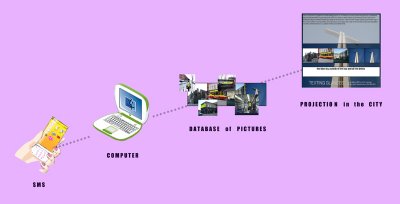
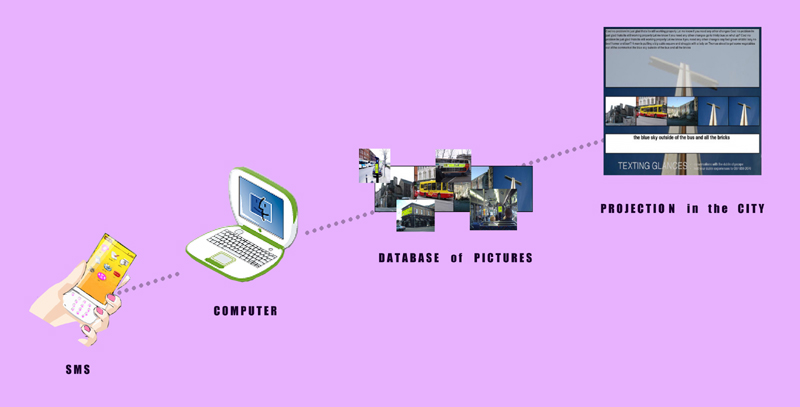
    Imagined for installation in an urban, public space (bus stop, train station, etc.), PASSING GLANCES invites people to use SMS messaging on their cell phones to post images or video to a public display board. Display boards in different cities would be connected to one another. The system intelligently draws in other imagery to support the content of what users posted to the board. The goal was to have individuals describe their physical space in a substantial way, without the limitations of distance.

    Through the supportive research on this application, I found that users were initially using SMS to experiment with the system, but then quickly preferred to make the unknown crowd react through anonymous posting to co-located users. On hindsight, this project had interesting implications for how digital technologies can mediate between how we assert ourselves privately and publicly within the physical space.

    Connected to a server, each user’s cell phone could browse inside of their personal computer to display videos, pictures, and sound files. This was done privately and anonymously. The SMS media (picture, text, audio, etc.) posted to the display board could only be retrieved by specific users at a reasonable distance. Because these messages are unpredictable, they create an atmosphere of surprise and excitement.

    People were motivated to explore the relationship of private and public roles through the act of anonymous posting in the physical space. However, I would like to expand the system to explore and model the public desire for “subversive” acts, their overlap with the desire to exchange new media and ideas, and how digital technologies can maximally support how these desires translate into the redesign of the physical space.

    I designed this project in collaboration with Sven Anderson, Glorianna Davenport, Linda Doyle and Katherine Moriwaki when I was a researcher at Media Lab Europe. The origin of this work was to bring my previous project Textable Movie into a urban sms interactive display.

    Web site
    More info about Passing Glances


    MOVING PICTURES
    In the MOVING PICTURES project, I have sought to develop interfaces where either digital data can be overlaid onto physical objects in a display space or physical objects can act as handles into the digital space.

    MOVING PICTURES offers children the opportunity to gather imagery from their environment in the form of short video clips captured on video camera platforms that we modified for the application. I wanted to provide a transparent experience for the user, in which cumbersome process of capturing and editing becomes fluid in the improvisation of a story is accessible as a way to create a final movie.

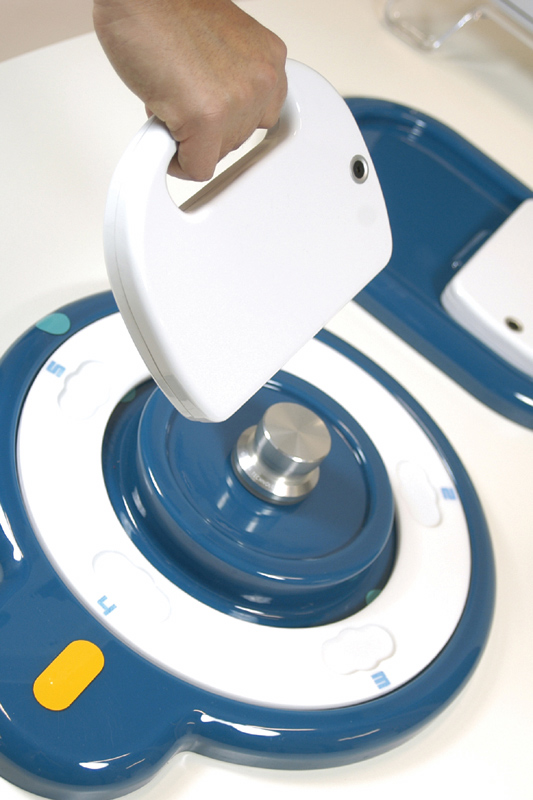
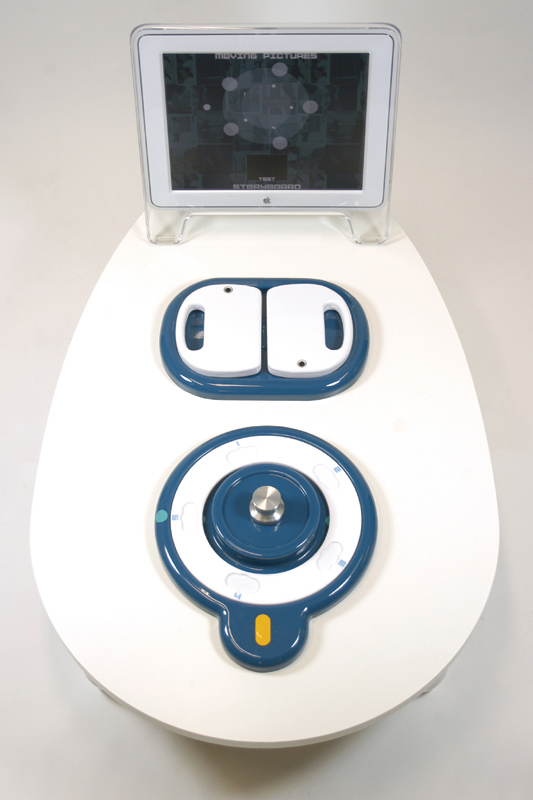
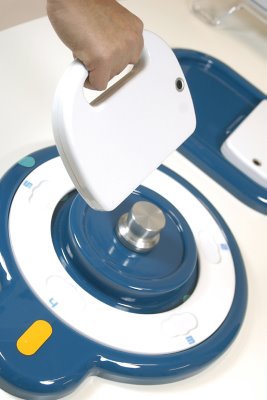
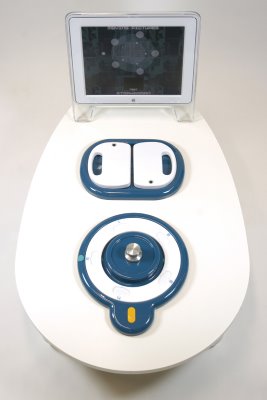
    For editing, MOVING PICTURES includes a multi-user workstation consisting a set of two cameras, tokens, screen and an interactive platform where users to create, explore, manipulate and share video content with others. Multiple device input to the workstation supports group interaction and collaborative creation.

    MOVING PICTURES suffers from several limitations related to the problem of how to best digitally support meaningful interactions in the physical space.

  • First the scalability of such system at a networked and international level is flawed. I need to redesign the software technology to centralize the linked data and distribute the nodes of contained data in an organized fashion. To have the technology better assist how an individual moves about the physical space while capturing content, their platform needs to be mediated by a centralized software architecture.


  • Second, system centralization implies new communication technology to mediate the video platforms and allow them to communicate with one another. The RFID technology in the wireless cameras could be redesigned into a pattern based technology using the video camera of any device.


  • Lastly, I would like to escape the hardware limitations of commercial video cameras. Users could use any phone, any camera or text based device to exchange material. The system should be designed to generalize despite different input modalities. All of these modifications shift the emphasis of the system from a simple, transparent, video platform, and into an architecture for supporting content generation that reflects the physical environment of the user through multiple information platforms.


  • I designed this project in collaboration with Diana Africano, Glorianna Davenport and Oskar Fjellstrom when I was a researcher at Media Lab Europe. The origin of this work was to bring my previous project Textable Movie into a tangible video editing platfofrm for children.
    More info on Moving Pictures


    TERRARIA
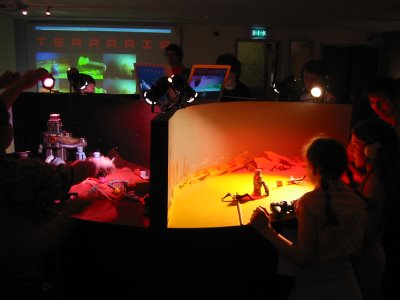
    TERRARIA was a system for visitors of a three-month exhibition in Dublin to author the content of the exhibition space by creating their own movies.

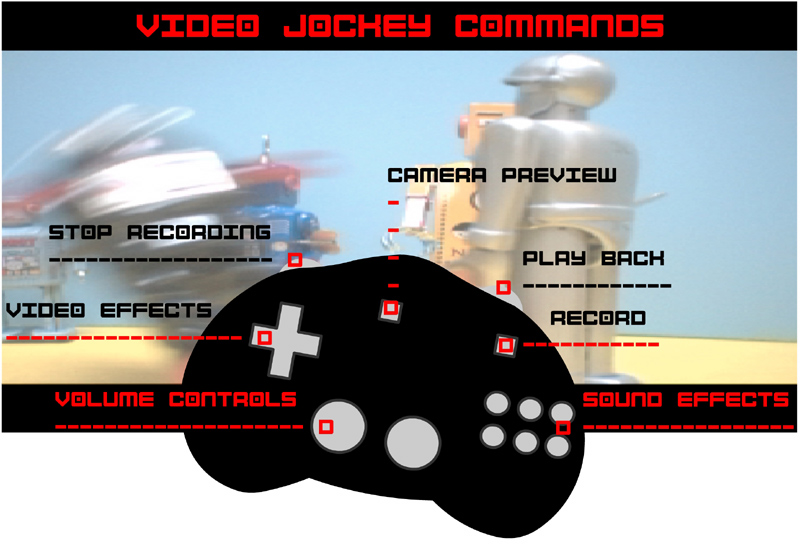
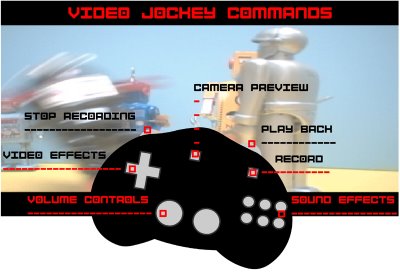
    I have designed a technology that enabled visitors to experience movie making using popular devices, e.g. a joystick to control the movie making process.

    I also re-thought real time video capturing and editing for the museum exhibition space by combining the traditionally separate capturing and editing processes. One can participate in the physical space through capturing video and export instantly to the digital space for the modification of the content they create.

    Finally, that content is projected within the museum, extending into the physical environment. Finally, the simplicity of use, and immediacy of response aims to engage visitors in movie creation. Video capture, editing and publication of the final video is optimized.

    With this interface I have attempted to expand the level of interaction for individuals in the physical museum space. Unlike the typical museum, spectators can transform and contribute to the physical exhibition space.

    Research on TERRARIA was primarily driven to optimize the video capturing and production process for the unique demands of the museum visitor and museum environment. The component of this work that is most exciting to me is the user capturing the physical space and immediately having the opportunity to re-project into that space with modifications of the video.

    If possible, I would like this process to be scaled across spaces, with distributed interfaces, and with computational models in place to describe how the users navigate the data representation and reproduction. Without the consistency of the museum I will need to rethink the display to visualize the content publicly. Investigating appropriateness of display and visualization create a critical component of all of this work.

    I designed this project in collaboration with Andrew Clancy, Michael John Gorman and Brendan Tangney when I was a researcher at Trinity College University in Dublin. Michael John Gorman was curating an exhibition on robots and offered me to design a platform for children to create and share their animations using robots.
    More info on Terraria


    PlayPals: Tangible Interfaces for Remote Communication and Play


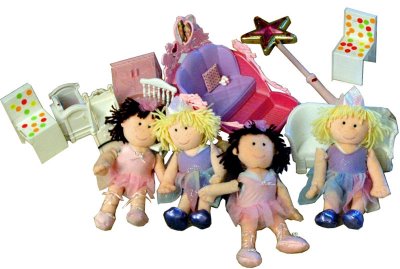
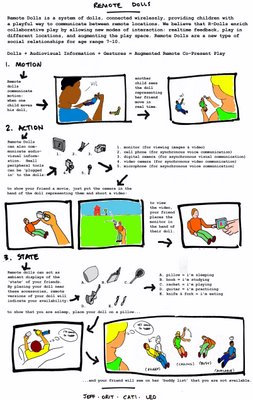
    PlayPals are a set of wireless figurines with their electronic accessories that provide children with a playful way to communicate between remote locations. PlayPals is designed for children aged 5-8 to share multimedia experiences and virtual co-presence. We learned from our pilot study that embedding digital communication into existing play pattern enhances both remote play and communication

    The project PlayPals is a team and class project for the Tangible Media class mid-term assignment at MIT Media Lab taught by Dr Hiroshi Ishii. It was presented as an extended Abstract of Conference on Human Factors in Computing Systems (CHI '06), (Montreal, Quebec, Canada. April 22-27, 2006) by Bonanni, L., Lieberman, J., Vaucelle, C., Zuckerman, O. (alphabetical order).

    Our concept poster


    On this picture I interact with the doll, Leo being on the other end


    Our implementation poster


    By Cati in computational toy design

    Tuesday, December 25, 2007

    Twas The Dark Knight Before Christmas

    Mechanical Santa


    Mechanical Santa Claus Toy: 1913. The patent for this toy Santa Claus was awarded to Mabry Lovejoy and Joshua D. Kuykendall in 1918.

    "The primary object of my invention is to provide an attractive Christmas toy arranged to be secured to a vertical support such as a wall, representing Santa Claus driving a team of deer hitched to a sleigh from the bottom of which stockings or other receptacles are suspended. The sleigh body serves to receive toys, candies and other articles and the receptacles secured below the same may also receive toys, nuts, confectionery, and the like."

    Found on Patent room

    Tuesday, December 11, 2007

    What I want for Christmas

    Patent: animal toy

    Patent

    An apparatus for use as a toy by an animal, for example a dog, to either fetch carry or chew includes a main section with at least one protrusion extending therefrom that resembles a branch in appearance. The toy is formed of any of a number of materials including rubber, plastic, or wood including wood composites and is solid. It is either rigid or flexible. A flavoring (scent) is added, if desired. The toy is adapted to float by including a material therein that is lighter than water or it is adapted to glow in the dark, as desired, by the addition of a fluorescent material that is either included in the material from which the toy is made or the flourescent material is applied thereto as a coating. The toy may be segmented (i.e., notched) so as to break off into smaller segments, as is useful for smaller animals or, alternatively, to extend the life of the toy. Various textured surfaces including camouflage colorings are anticipated as are straight or curved main sections. The toy may be formed of any desired material, as described, so as to be edible by the animal.

    Monday, December 10, 2007

    When artists make toys


    When artists make toys by Hellmuth, Obata & Kassabaum Architects, Inc. on Aiga

    Sunday, December 9, 2007

    Ananooooooo


    More about Anano

    Little creature


    By Haycorns

    Saturday, December 8, 2007

    Lego ad


    More Lego ads

    Kit


    A kit to assemble these little plastic creatures, of course signed IDEO by Andy Deakin, Ian Groulx and Peter Riering-Czekalla.

    Enemy combatant


    Enemy combatant by Volume Inc.

    Black Dog


    In the BlackDog, “Gi, Go”, by Mark Fox even the poo is cute.

    Plush doctor


    A plush doctor by Kevin Farnham

    A sad pinky thing


    By Alyssa Campbell as part of a night of adults toys.

    The usual suspects


    For best results apply to body parts not already outlined in chalk. All one size. Twenty-five sterile strips.

    Dog lamp


    A playful dachshund plastic lamp with a low voltage (12v) replaceable bulb that bathes a room in soft light. Perfect for cold winters.

    Angel de Franganillo


    Finding with Patapulpo by
    Angel de Franganillo


    Quand les chiens posent ...


    Un dalmatien pas comme les autres, photo by Olga Samuels

    Sequence


    Illustration by RBG6

    Friday, December 7, 2007

    Animals on your finger


    More here

    Retro time


    Retro radio


    Retro TV alarm clock

    The squishable


    The first stuffed animals to not suffer from you sleeping on them. These guys come already squeezed!

    Un chandelier pas comme les autres

    Hanging overhead, "El Chandelier" is a wonder to behold. A six-foot tall chandelier crawling with thousands of tiny knickknacks, the work glitters against the ceiling and is breathtaking in its degree of detail. A source of light and humor, the bulbs of "El Chandelier"are surrounded by little plastic palm trees, tassels, kewpie dolls, and golden cups. Squirt guns, fake pearls, dominoes, toy cars, miniature bowling pins, and an assortment of plastic animals - swans, giraffes, monkeys, rhinos - drip from every available surface. Dangling from golden perches are plastic babies. Above them, small girl dolls mingle with plastic white doves.


    El Chandelier (The Chandelier) by Pepon Osorio, 1988. Mixed media; 78 x 48 inches in diameter.

    In Osorio's quirky hands, scarlet fingernail extensions become bright spots of color in a dazzling, suspended gem. While lush with items from popular culture, the work's exuberance veils a deeper seriousness. Dizzy in its abundance, the sadness of "El Chandelier" is the sadness of a people who often lack the most basic of modern necessities such as money, health care, and access to education. An assault of cuteness, the work celebrates the beauty of kitsch and carnival while underlining the way in which an overblown or "tacky" aesthetic can be a critique of the prevailing and often puritan tastes of a dominant culture. In sharp contrast to the crisp corners and stark white walls of the wealthy galleries in which it is often shown, the accumulation of hand-glued objects in "El Chandelier" seems purposefully out of place - Art 21


    Pepón Osorio b.1955, La Cama (The Bed) 1987, Mixed Media Installation